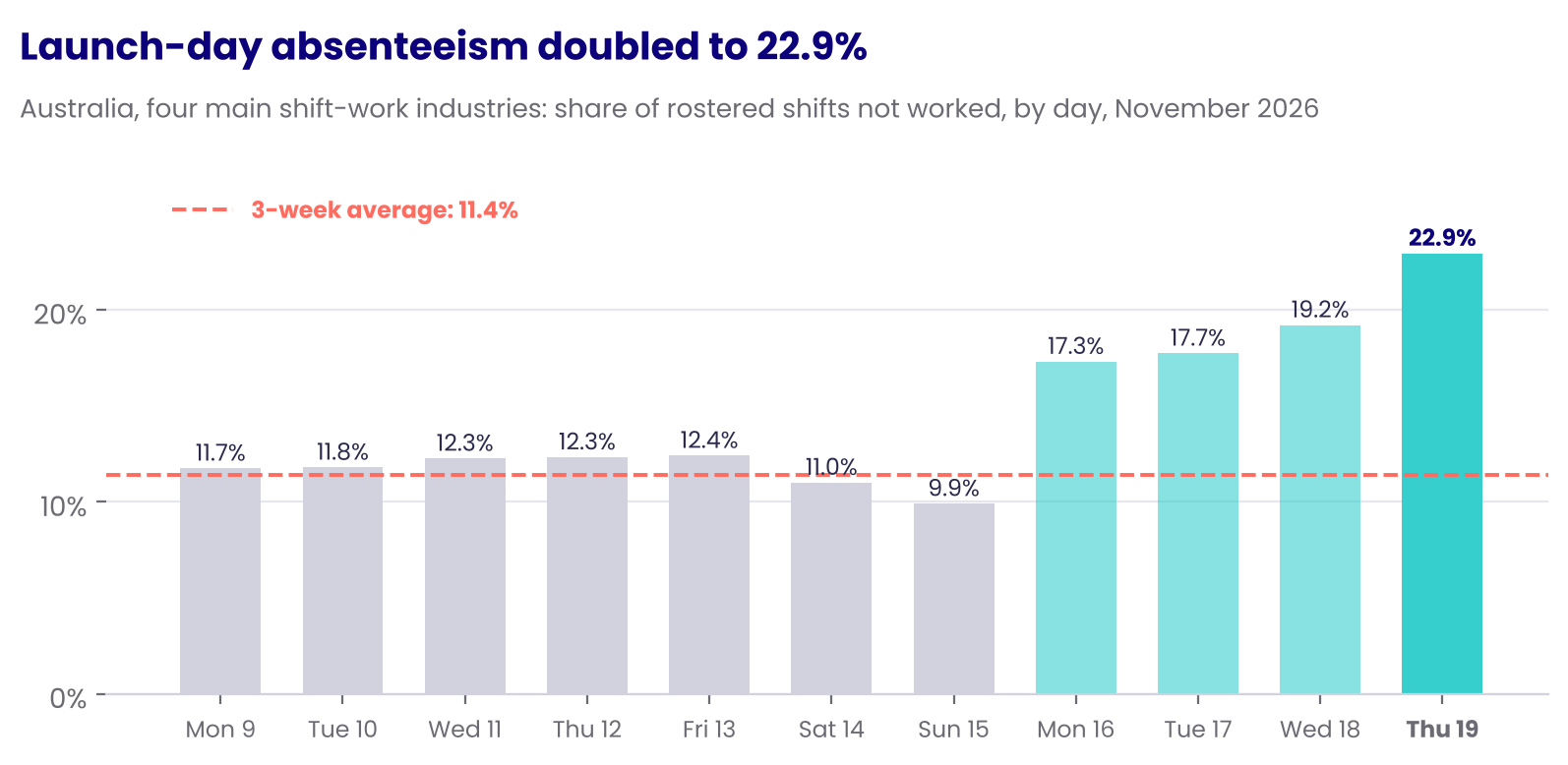
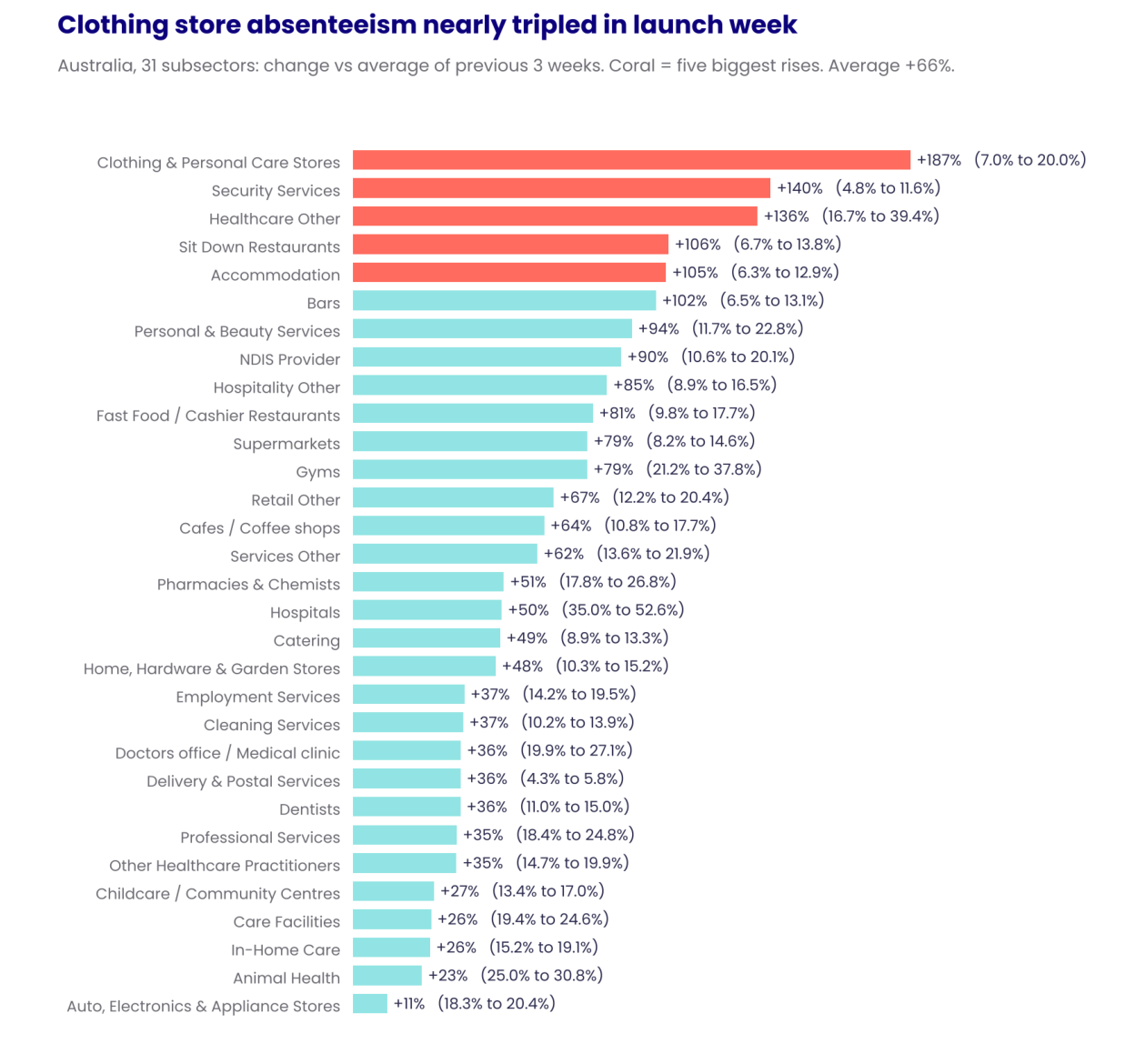
Hospitality was hit hardest. Normally about one shift in twelve goes unworked; on launch day it was nearly one in five, more than double the usual rate. Retail also more than doubled, with a quarter of shifts unworked. Healthcare rose least (+64%), but still had the highest rate of any industry: 28.8% of shifts went unworked. Counted in hours, the picture is the same: 22.1% of rostered hours went unworked on launch day, up 114%.
Both men and women stayed away. Men’s absenteeism nearly tripled on launch day (+182%), and women’s rose 152%.
The “GTA flu” forecast came true
Before launch, the media widely predicted a “GTA flu”. Deputy’s own forecast, reported in October, was that a blockbuster game launch can lift shift-work absenteeism by roughly 90% or more, and that the day before launch is a risk too. Deputy advised employers to treat Wednesday 18 to Friday 20 November as one high-risk window.
The data bears that out. Launch-day absenteeism rose 101% on the three-week average, and 86% on the previous Thursday. The day before was up 69%.
Across the whole launch week
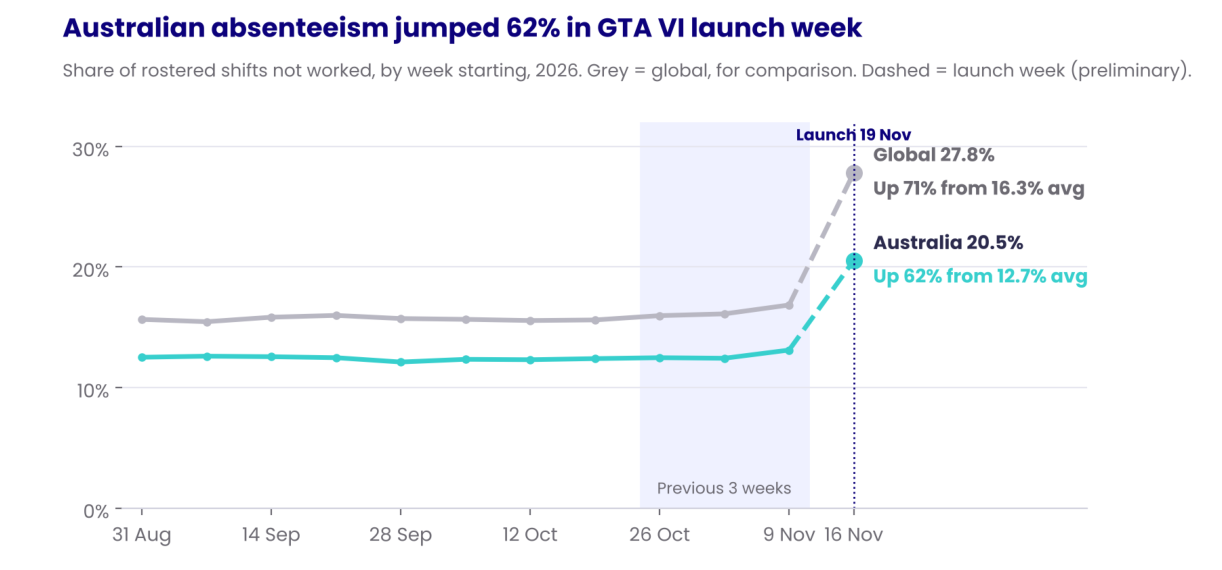
Across all Australian shift workers, launch week as a whole saw one in five rostered shifts (20.5%) go unworked, up 62% on the average of the previous three weeks. That is the highest weekly rate in Australia since April 2025.
For two months before the launch, absenteeism barely moved, sitting between 12.1% and 12.6% each week. In the week pre-loads opened (9 November) it ticked up to 13.1%, up 5%. Then, in launch week, it leapt to 20.5%.
Counting hours instead of shifts tells the same story. The share of rostered hours that went unworked rose 62%, from 11.3% to 18.4%.
This was not just an Australian event. Worldwide, absenteeism rose 71% in the same week, to 27.8%. A jump that big, in the same week, in many countries at once, points to the launch rather than anything local. A year earlier, the same week in Australia was 2% below the average of the three weeks before it.
Men’s absenteeism nearly tripled on launch day
Men and women went into launch week level: both had an average absenteeism rate of about 7.3% over the previous three weeks. On launch day, men’s rate nearly tripled to 20.2% (+182%). Women’s rate more than doubled to 18.5% (+152%).
Men also moved first. On the day before launch, men’s absenteeism was up 127%, against 103% for women. Counted in hours, the gap is wider still: men’s unworked hours on launch day were up 244%, women’s 175%.