Payday Super starts
1 July: There's still
time to get set up
Review your payroll set-up now, so you’re ready. With Deputy Payroll, Payday Super is built into your pay run.





TRUSTED BY 390,000+ WORKPLACES ACROSS THE GLOBE


TRUSTED BY 390,000+ WORKPLACES ACROSS THE GLOBE
What is Payday Super?
Payday Super changes how and when you pay Super to employees. With the new changes coming into effect, Super must now be paid at the same time as wages, regardless of whether you run payroll weekly, fortnightly, or monthly. For payroll teams, this is a big shift for your day-to-day payroll operations
–and now is the best time to prepare.
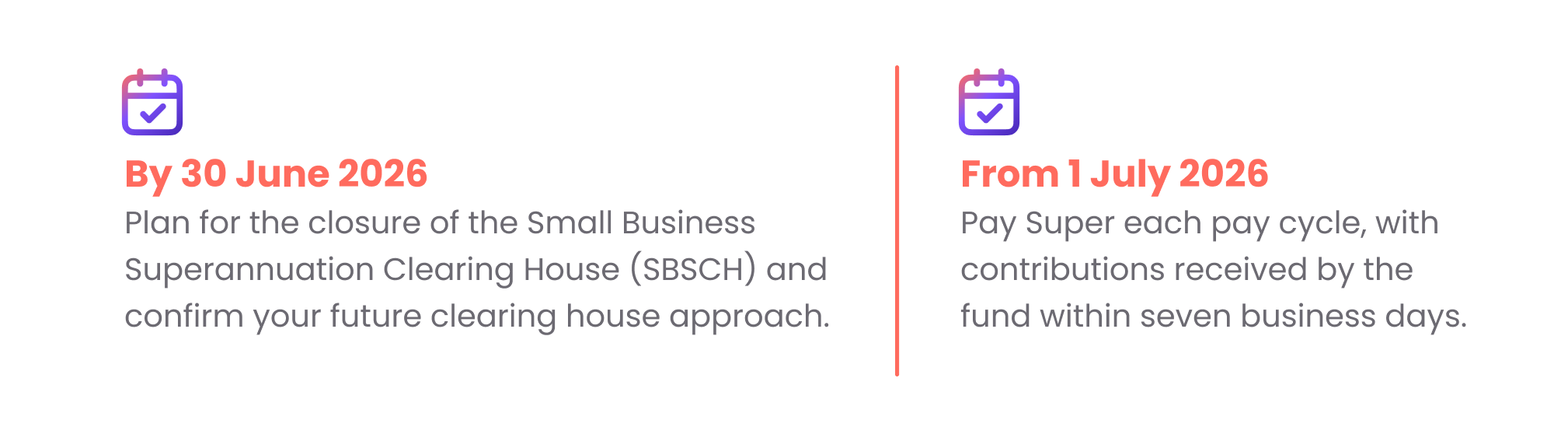
Payday Super Key Dates
Get Payday Super ready by reviewing your current payroll process and staying up to date with ATO on timelines and changes.
3 things your payroll team needs to know

1. More frequent Super payments
You’ll need to move from quarterly to pay-cycle Super.
Weekly payers: 48 extra Super payments per year
Fortnightly payers: 22 extra Super payments per year
Monthly payers: 8 extra Super payments per year

2. Tighter timeframes
Super contributions must be paid to the employee’s fund at the same time you pay qualifying earnings (QE), on payday—within 7 business days. Shorter timeframes mean payroll teams have less room for errors, delays, and messy, manual processes.

3. Ongoing cash flow management
Finance teams must move from a quarterly Super accrual model to a weekly/fortnightly disbursement model, with funds having to be readily available every payroll cycle.
Don’t forget your clearing house
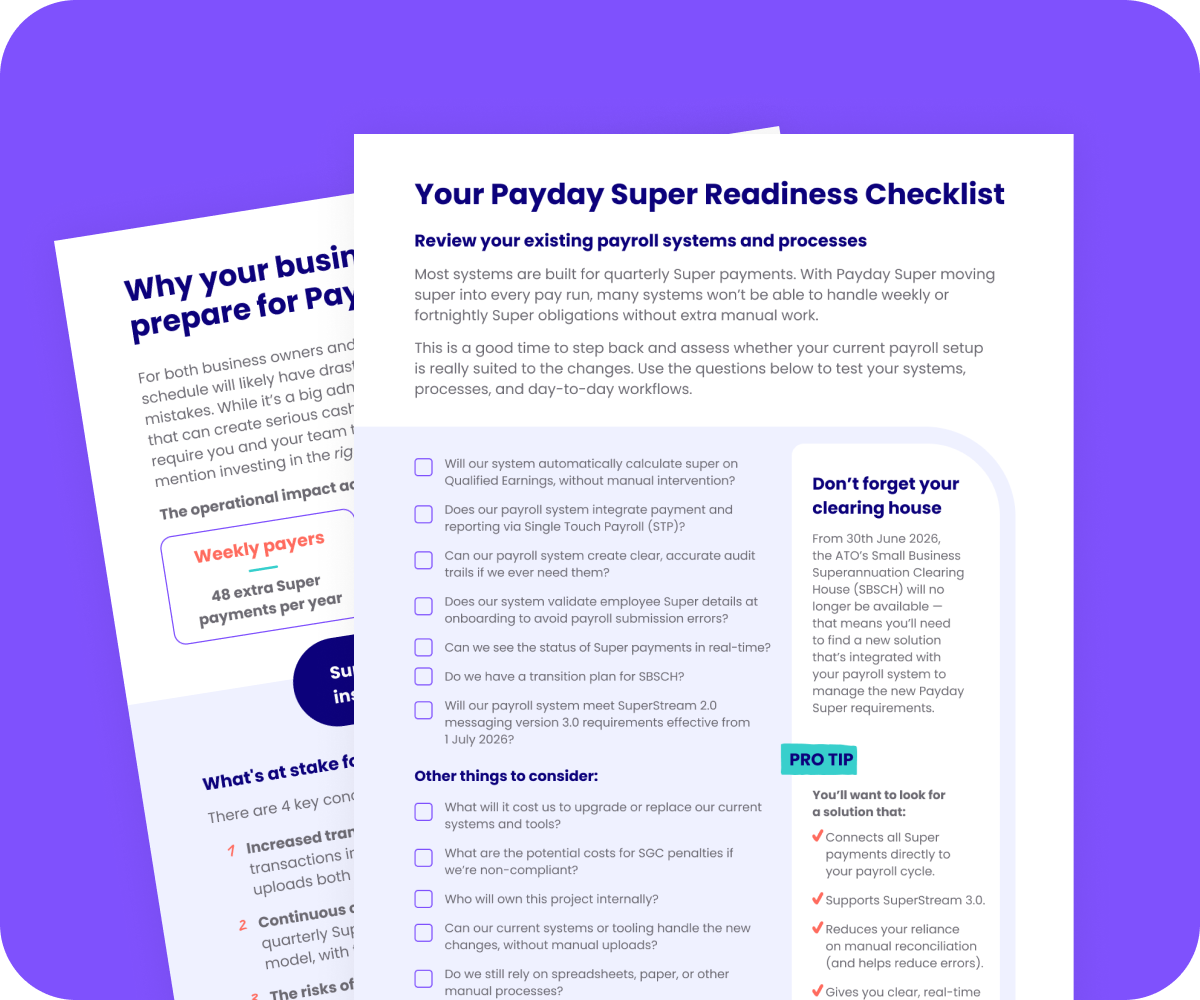
From 30 June 2026, the ATO’s Small Business Superannuation Clearing House (SBSCH) will no longer be available—that means you’ll need to find a new solution that’s integrated with your payroll system to manage the new Payday Super requirements.
You’ll want to look for a solution that:
Connects Super payments to your payroll cycle
Supports SuperStream 3.0
Reduces your reliance on manual reconciliation (and helps reduce errors)
Gives you clear, real-time visibility into things like refunds or bounce-backs
Payday Super FAQs
- When does Payday Super start?
Payday Super starts on 1 July 2026. From this date, employers will be required to pay employees’ super at the same time as wages, rather than quarterly. Preparing early gives businesses more time to understand the changes and adjust payroll processes with confidence.
- Do I still have until the end of the quarter to pay super?
No. From 1 July 2026, super must be paid on payday. The current quarterly payment option will be replaced, meaning super contributions need to be paid at the same time as employees are paid. This change is designed to align super with payroll to strengthen retirement savings and tackle unpaid super.
- Do I still pay super on Ordinary Time Earnings (OTE)?
No. Under Payday Super, the new base for calculating Superannuation Guarantee (SG) is Qualifying Earnings (QE) instead of OTE. QE includes all commissions and some additional salary sacrifice amounts as well as all Ordinary Time Earnings. It also may include payments to some contractors so it’s important to review what counts as qualifying earnings for each worker. Updating payroll systems ensures super is calculated correctly every pay run.
- What happens if I miss a super payment?
Under Payday Super, late or unpaid contributions can trigger the Superannuation Guarantee Charge (SGC), which includes the outstanding super, interest, and an administration charge. Paying super on time each pay run helps avoid these costs and keeps you compliant.
- How can Deputy Payroll help with Payday Super?
Deputy Payroll handles Payday Super within your normal pay run workflow, so it’s not something your team has to manage separately. You can automate complex super calculations with every pay run, keep wages and super together in one place, and maintain clear audit trails. It’s a unified platform for shift-based businesses to manage rostering, timesheets, pay runs, and super while helping simplify compliance.
- How does Deputy Payroll support Payday Super across multiple entities or ABN branches?
Deputy Payroll lets you manage multiple businesses or ABN branches within one account, while running separate payrolls for each entity as needed. Payday Super is handled within the normal pay run workflow, with payments attributed to the correct entity. And if employees work across locations, Deputy Payroll helps make sure payroll and Payday Super are processed correctly.
- How does Deputy help with super stapling for new employees?
Deputy HR includes super stapling, which helps employers identify an employee’s existing stapled super fund when they start a new job. This makes it easier to pay super to the correct fund from the beginning. For Payday Super, that can help reduce errors, support compliance, and keep payroll moving smoothly by making sure the right fund details are in place before super is paid through Deputy Payroll.
- How quickly does super need to be received by the employee’s super fund?
Super payments must reach the employee’s super fund within 7 business days of payday. This makes it important to run payroll accurately the first time, any bounced or reprocessed payments could delay super reaching employees on time. Using a payroll solution that has an embedded superannuation clearing house is key to on-time super.
- Do the Payday Super rules apply to casual or part-time staff?
Yes. Payday Super applies to all employees, including casual and part-time staff. Super entitlements must be paid on each payday, regardless of hours worked or employment type.
- How will PDS affect cash flow?
Payday Super can affect cash flow because super must be paid on each payday, not quarterly. This means funds need to be available more frequently, so planning ahead is important.
- Can I change my pay frequency to help manage cash flow under Payday Super?
In some cases, yes. If your modern award or enterprise agreement allows it, you may be able to change how often you run payroll to better manage the cash flow impact of Payday Super. Because pay frequency can affect employee entitlements and compliance obligations, it’s important to check the rules that apply to your business before making any changes.
How Deputy can support your
Payroll teams with Payday Super
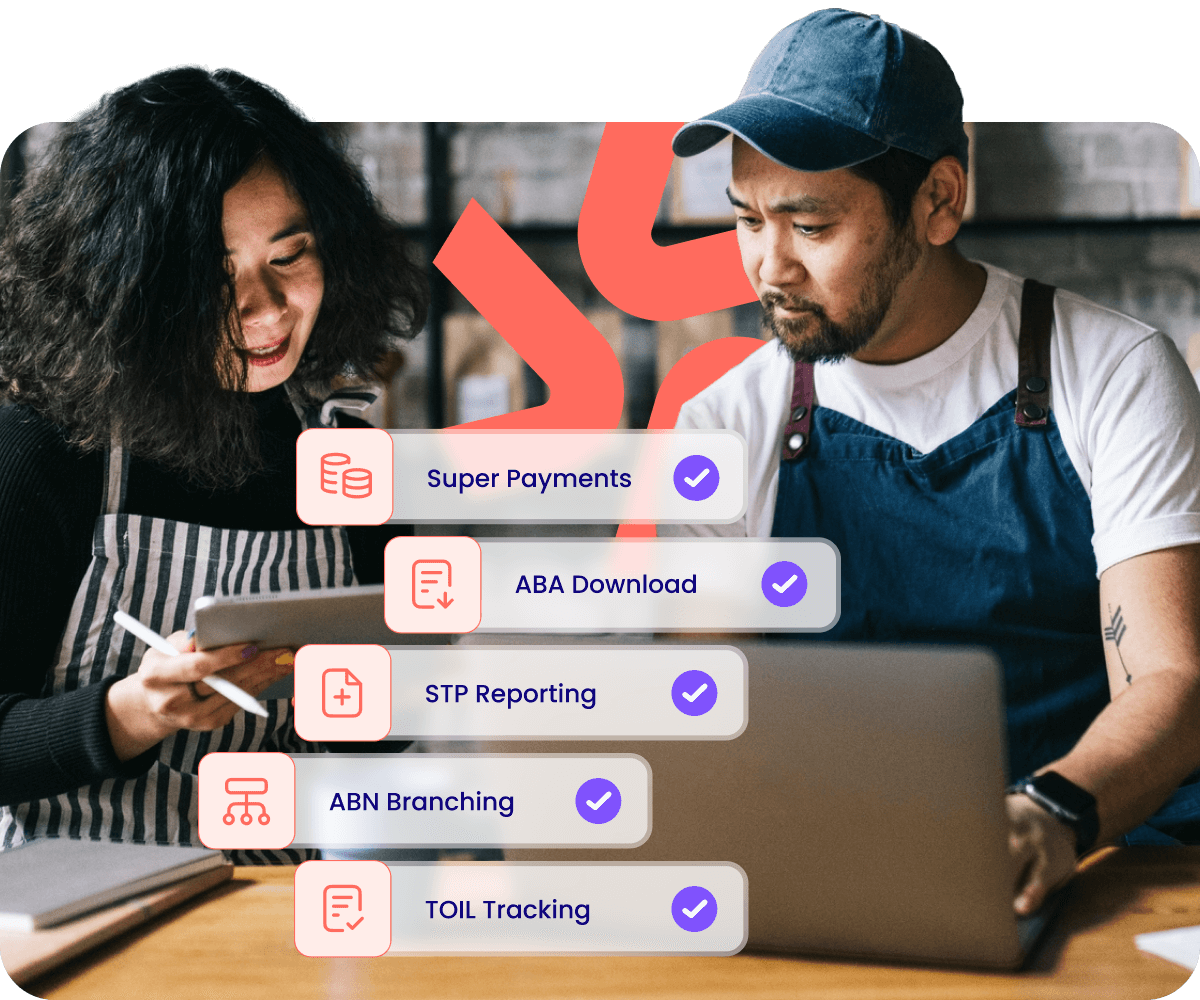
With Deputy Payroll, Payday Super is built into the pay run workflow, so your team can manage super and wages together in one flow. You can automate complex super calculations with every pay run, maintain clear audit trails, and manage multi-entity and ABN branching in one account. It’s designed to simplify compliance and reduce admin for shift-based businesses.

Payday Super built into pay run
With Deputy Payroll, Payday Super is handled within your normal pay run workflow, so your team can manage wages and super together in one place instead of as a separate process.

Integrated payroll
Deputy Payroll makes it easy to connect timesheets, pay runs, and Super processes in one platform, helping reduce the burden of endless admin work (especially as payment frequency increases).

Clearing house support
With the upcoming SBSCH closure, you’ll need a unified payroll platform with clearing house functionality—and that’s where Deputy comes in.

Multi-entity payroll support
Run payroll across multiple entities or ABN branches in one Deputy account, with Payday Super attributed to the relevant entity, even when employees work across locations.

Validation of super details
Deputy HR validates employee Super fund details during onboarding via SuperAPI. This avoids reprocessing, protects cash flow, and helps meet the 7-day window.

Correct super fund from day one
With super stapling in Deputy HR, you can identify an employee’s existing super fund during onboarding, helping reduce errors and keep Payday Super payments on track.
Visibility into upcoming wages
With super moving to pay-run payments, cash flow visibility becomes essential. Deputy shows upcoming wage costs before each pay run, helping you plan ahead and avoid surprises.

Designed for shift-based payroll
Deputy is built for shift-based businesses, helping you automate complex pay rate calculations and reducing the manual work payroll teams have with variable hours and rosters.

Clear, auditable records
Use Deputy Payroll to simplify payroll and help keep it accurate; digital payroll and Super records support reporting and reviews, so you’re ready if an audit arises.
Get Payday Super ready with Deputy
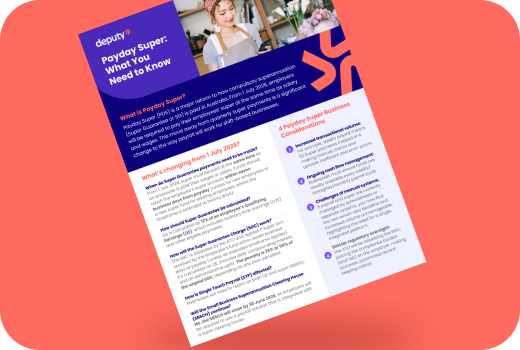
Mastering Payday Super
Everything you need to know about Payday Super, including operational, cash flow and systems impacts.


Mastering the Operational Shift
Understand why Payday Super is a fundamental change to your daily workflows, requiring faster data validation and the elimination of manual payroll buffers.


Prepare for Payday Super with Deputy
Payday Super means your business will have to make a big shift. Prepare now to have time to assess your options, select the best platform for your Payroll needs, and test multiple pay runs before launching on 30 June 2026.
That’s where Deputy Payroll comes in. It’s designed for shift-based businesses to help automate complex Super calculations with every pay run, while keeping wages and Super together in one place. Our platform helps you maintain records with clear audit trails, while working seamlessly with your existing tools.
Want to learn more about Deputy’s payroll and compliance tools? Book a demo with our experts today or start your free trial of Deputy.
More resources for Australian payroll teams



Deputy Payroll,
from timesheets to pay in seconds
Disclaimer: While Deputy's platform is designed to simplify shift work and payroll through automation, this document is for informational purposes only and does not constitute legal or financial advice. It is ultimately each customer's sole responsibility to pay their employees correctly and in compliance with all legal and regulatory requirements. Please review our Product Specific Terms for more information.